How Does Structural Monitoring Work? A Complete Guide
Learn how structural health monitoring works — from IoT sensors, through data transmission, to an online dashboard with alerts. A practical guide for investors and engineers.
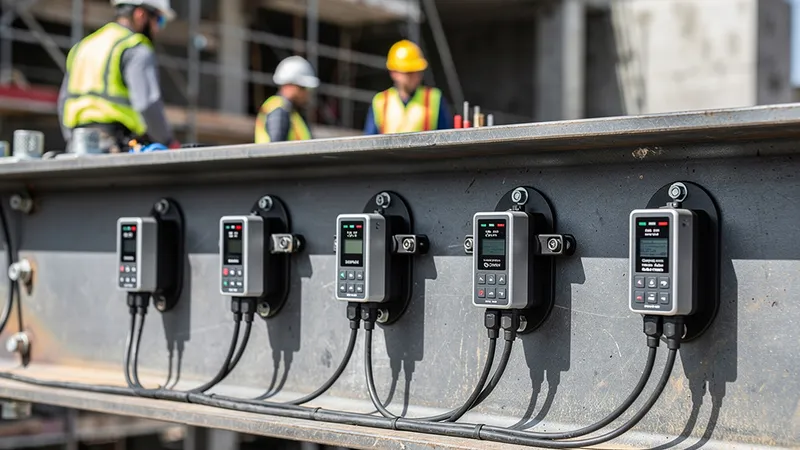
Structural monitoring is a system of continuous supervision over the technical condition of a building or engineering structure. It detects concerning changes — deformations, tilts, stresses — before they become a threat to user safety.
In this article, we explain how structural monitoring works step by step: from sensors mounted on the structure, through data transmission and processing, to an online dashboard with automatic alerts.
What is structural monitoring?
Structural monitoring (Structural Health Monitoring, SHM) is a set of methods and technologies for continuous or periodic measurement of the physical parameters of a building structure. The goal is to assess the structure’s condition in real time and detect anomalies early.
Importantly, structural monitoring has a legal basis — § 204(7) of the Polish Regulation of the Minister of Infrastructure (Journal of Laws 2022, item 1225) requires that public buildings with rooms designed for large numbers of people (sports halls, entertainment venues, exhibition halls, shopping centres, railway stations) be equipped with devices for continuous monitoring of parameters critical to structural safety.
Monitoring systems are used on:
- stadiums and sports halls — large-span roofs subjected to wind and snow loads
- heritage buildings — structures requiring special conservation protection
- bridges and viaducts — monitoring of deflections, vibrations and corrosion
- warehouse and production halls — continuous monitoring of loads and steel structure condition
- buildings in construction impact zones — monitoring the effect of construction on neighbouring structures
What does a monitoring system consist of?
Every structural monitoring system comprises three layers:
1. Measurement layer — sensors
Sensors are the fundamental element of the system. Depending on the structure type and monitored parameters, we use:
- Strain gauges — measure deformations and stresses in steel or concrete elements
- Inclinometers — measure the tilt angle of structural elements (columns, walls)
- Load cells — measure loads at supports, tendons and anchors
- Displacement sensors (LVDT) — record movements between structural elements
- Weather stations — measure wind speed and direction, temperature, snowfall
- Accelerometers — record vibrations and dynamic loads
Sensors are mounted at critical points of the structure — at locations of highest stress, at connections, in support zones. Their placement is determined by the monitoring system design, developed based on the structural calculation model.
2. Transmission layer — data acquisition and transfer
Data from sensors is collected by data acquisition units (data loggers), which:
- read analogue and digital signals from sensors
- convert raw values into physical units (kN, mm, °C)
- buffer data locally in case of connectivity loss
- transmit data to the server via cellular network (LTE/5G), Ethernet or Wi-Fi
At Ryzer, we use industrial data loggers with memory and communication redundancy. Data is transmitted encrypted and sent to the cloud, where it is archived and made available through the dashboard.
3. Analytics layer — dashboard and alerts
The online dashboard is the interface through which users observe the structure’s condition. Key dashboard functions:
- Real-time charts — current readings from each sensor with measurement history
- Alarm thresholds — automatic notifications (email, SMS) when defined limit values are exceeded
- Periodic reports — automatically generated summaries of the structure’s condition
- Data correlation — comparison of readings with atmospheric conditions (e.g. snow load vs. roof deformation)
- Data export — ability to download raw data for independent analysis
How is monitoring implemented?
Implementing a structural monitoring system involves several stages:
Stage 1: Analysis and design
Based on project documentation, the calculation model and investor requirements, we develop the monitoring system design. We determine:
- what parameters to measure (deformations, tilts, forces, weather conditions)
- how many and what type of sensors are needed
- where to mount them (critical points of the structure)
- what alarm thresholds to set
- how to transmit data (LTE, Ethernet, Wi-Fi)
Stage 2: Installation and calibration
Sensors are mounted on the structure according to the design. After installation, each sensor is calibrated — we set zero values and verify the correctness of readings. Data loggers are installed in control cabinets that protect the electronics from weather conditions.
Stage 3: Dashboard launch and configuration
After calibration, we launch data transmission and configure the dashboard:
- define alarm thresholds (warning and alarm)
- set notification recipients
- configure data recording frequency
- verify correct operation of the entire measurement chain
Stage 4: Operation and support
The system operates autonomously 24/7. Ryzer provides ongoing technical support — we monitor system availability, update software and respond to hardware failures.
When does monitoring work in real time?
Real-time monitoring means that sensor data is read continuously (every few seconds) and immediately transmitted to the dashboard. This mode is essential when:
- the structure is exposed to sudden loads (wind, snow, crowds)
- the structure shows signs of damage and requires constant observation
- the building project or building supervision authority requires it
- the structure is in use and real-time safety assurance is needed
For long-term monitoring (e.g. foundation settlement), readings every few minutes or hours may be sufficient.
How much does structural monitoring cost?
The cost of a monitoring system depends on several factors:
- scale of the structure — number of measurement points and sensor types
- structural complexity — a single roof vs. an entire building
- project requirements — whether monitoring is required by the brief or is additional
- duration — monitoring during construction vs. permanent operational monitoring
- dashboard scope — basic view vs. advanced analytics with BMS integration
A typical monitoring system for a medium-scale structure (stadium, hall) costs from tens to hundreds of thousands of PLN. We prepare a detailed quote after analysing the structure’s documentation.
Summary
Structural monitoring is a system that combines sensors, data transmission and online analytics into a single tool for continuous supervision of a structure’s safety. It detects problems before they become serious — and enables decisions based on data, not guesswork.
If you’re planning to implement monitoring on your structure — get in touch. We’ll design a system tailored to your structure.